Wild Files · Species File No. 27 · Lichen
Witch's Hair Lichen
Alectoria sarmentosa
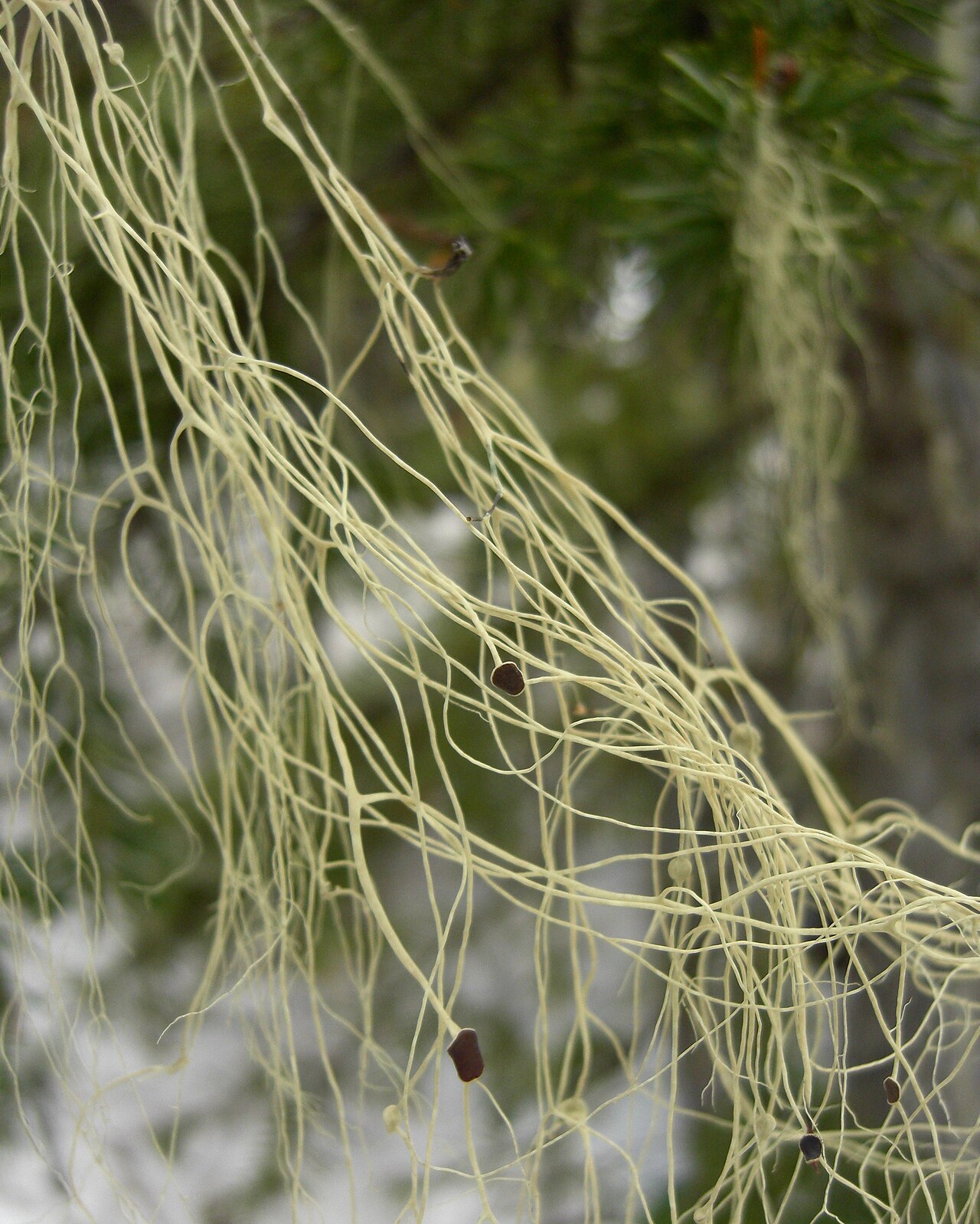
Meet the Witch's Hair Lichen
Fact block — copy it for your StoryMap
Witch's hair lichen looks like pale, stringy hair hanging from tree branches. It is grayish-green to yellowish-green, and its many thin branches tangle into mats that can be up to 10 to 30 centimeters long. A lichen is two living things working as one team. A fungus (the part you mostly see) teams up with tiny algae (tiny plant-like living things). The algae make food from sunlight and share it with the fungus.
Witch's hair lichen drapes from conifer branches in pale, stringy clumps, ranging from grayish-green to yellowish-green and sometimes blackening at the tips. It is a fruticose lichen, meaning it grows in branching, hair-like strands rather than flat patches. Long mats of 10 to 30 centimeters hang down in a pendulous way, sometimes forming curtain-like sheets. A lichen is not one organism but a partnership: a fungus provides the structure, while algae living inside use sunlight to photosynthesize, making food the fungus cannot make on its own. Together they form a single long-lived, perennial organism with no roots, stems, or leaves.
Where It Lives
Fact block — copy it for your StoryMap
You can find witch's hair lichen in cool, wet rainforests like those in Washington, where the Hoh Rain Forest grows. It likes old forests with very large, old trees, called old-growth forests. It hangs from conifer branches near gaps in the treetops, where sunlight reaches the middle of the forest. The lichen has no roots. It clings to branches and soaks up what it needs from the rain and air around it.
Witch's hair lichen lives across the temperate rainforests of the northern hemisphere, including the Pacific Northwest states of Washington, Oregon, Alaska, and beyond. That range covers the wet, mossy forests of Olympic National Park, where the Hoh Rain Forest sits. The species is closely tied to old-growth forests, the ancient stands of very large, old trees, and it thrives along canopy-gap edges where sunlight filters into the lower and middle layers of the forest. Because it has no roots, it anchors to conifer branches and absorbs moisture and nutrients directly from rain and the surrounding air.
Its Job in the Rainforest
Fact block — copy it for your StoryMap
This lichen is food and supplies for forest animals. Deer and caribou nibble it from low branches, or eat it off the snow when wind knocks it down. Flying squirrels eat it too, and use it to build their nests. Witch's hair lichen is also a clue about clean air. It soaks up pollutants (harmful stuff in the air), so scientists test it to see how clean the air is. Healthy lichen is a sign of a healthy forest.
Witch's hair lichen is both groceries and building material for rainforest wildlife. Sitka black-tailed deer and caribou browse it from reachable low branches or gather it from the snow after wind blows it down, and flying squirrels both eat it and weave it into their nests. The lichen also acts like a living air-quality monitor. Because it absorbs pollutants straight from the atmosphere, scientists collect it for tissue analysis to detect changes in air quality, which makes it a sensitive early-warning tool. Long ago, Indigenous peoples used its fibers for items such as bandages and baby diapers. When this lichen is thriving, it signals a forest with clean air and healthy old trees.
Fast Facts
Fact block — copy it for your StoryMap
- Scientific name: Alectoria sarmentosa, in the lichen family Parmeliaceae
- What it is: a lichen, a partnership of a fungus and algae living as one
- Looks like: pale grayish-green strands hanging from conifer branches, up to 10 to 30 cm long
- Home: northern temperate rainforests including Washington, often in old-growth forests
- Who eats it: deer, caribou, and flying squirrels; squirrels also nest with it
- Air detective: absorbs pollutants, so scientists use it to test air quality
Where these facts come from
USDA Forest Service · Wikipedia · iNaturalist — real photos & sightings