Wild Files · Species File No. 28 · Amphibian
Olympic Torrent Salamander
Rhyacotriton olympicus
Found only here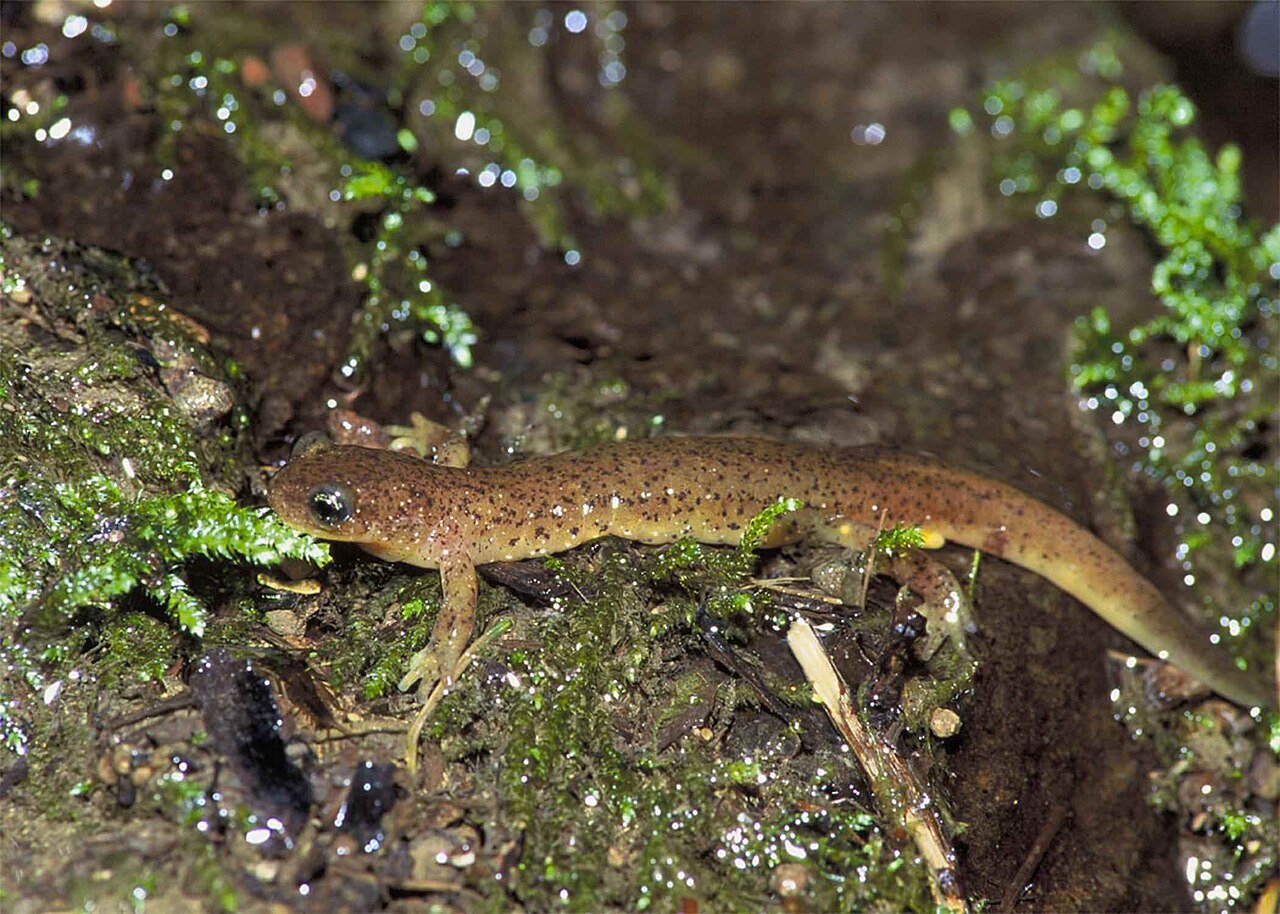
Meet the Olympic Torrent Salamander
Fact block — copy it for your StoryMap
The Olympic torrent salamander is a tiny amphibian, which means it lives part of its life in water. It is only about 12 centimeters long, a little shorter than a new pencil. It has a brown back, a yellowish belly, and big eyes. A torrent is a fast-rushing stream, and that is exactly where this little salamander loves to be.
The Olympic torrent salamander is a small amphibian that grows to roughly 12 centimeters in total length, about the size of your hand. Look closely and you will notice its large, swollen eyes, a brown back speckled with pale flecks along the sides, and a yellowish underside. Its name comes from the word torrent, meaning a fast, churning stream. One curious detail: its lungs are unusually small for its body, so it relies heavily on its moist skin to take in oxygen. That is why staying near cold, splashing water matters so much to it.
Where It Lives
Fact block — copy it for your StoryMap
This salamander lives only on the Olympic Peninsula in Washington, the same area that holds the Hoh Rain Forest. It needs clear, cold mountain streams. You might find it hiding under gravel at the edge of a stream, or even in the misty spray near a waterfall. It does not live in trees or open meadows. Its whole world is cold, running water and the wet rocks beside it.
The Olympic torrent salamander makes its home on the Olympic Peninsula of Washington, the region that surrounds the Hoh Rain Forest in Olympic National Park. It depends on clear, cold mountain streams and springs inside temperate forests. Search for it under loose gravel at the stream's edge or in the spray zone of a waterfall, where the air stays cool and damp. It can actually be abundant in these spots when conditions are right. Because it needs chilly, fast-moving water, you will not find it climbing trees or crossing dry meadows. Its life is tied to the streambed.
An Olympic Endemic Worth Watching
Fact block — copy it for your StoryMap
This salamander is endemic to the Olympic Peninsula. Endemic means it is found naturally in only one place on Earth and nowhere else. Scientists watch endemic animals closely, because if their one home is harmed, the whole species could be in trouble. The IUCN, a group that tracks wildlife, lists it as Near Threatened, mostly because of habitat loss. Caring for cold, clean streams helps keep this special creature safe.
The Olympic torrent salamander is endemic to the Olympic Peninsula, which means it lives naturally in this one region of the world and nowhere else. Endemic species deserve special attention from scientists because they have no backup home. If their single habitat is damaged, there is no other wild population to fall back on. The IUCN, an organization that assesses the health of species worldwide, classifies this salamander as Near Threatened, and habitat loss is the main concern. Protecting the cold, clear streams of the Olympic Peninsula is one of the most direct ways people can help this animal hang on.
Fast Facts
Fact block — copy it for your StoryMap
- Scientific name: Rhyacotriton olympicus
- Size: up to about 12 centimeters (4.7 inches) long
- Home: endemic to the Olympic Peninsula, Washington
- Habitat: clear, cold mountain streams, springs, and waterfall spray zones
- Conservation status: Near Threatened (IUCN), mainly from habitat loss
- Cool fact: its lungs are tiny, so it breathes largely through its moist skin
Where these facts come from
IUCN Red List · Wikipedia · iNaturalist — real photos & sightings