Wild Files · Species File No. 08 · Bird
Northern Spotted Owl
Strix occidentalis caurina
Federally threatened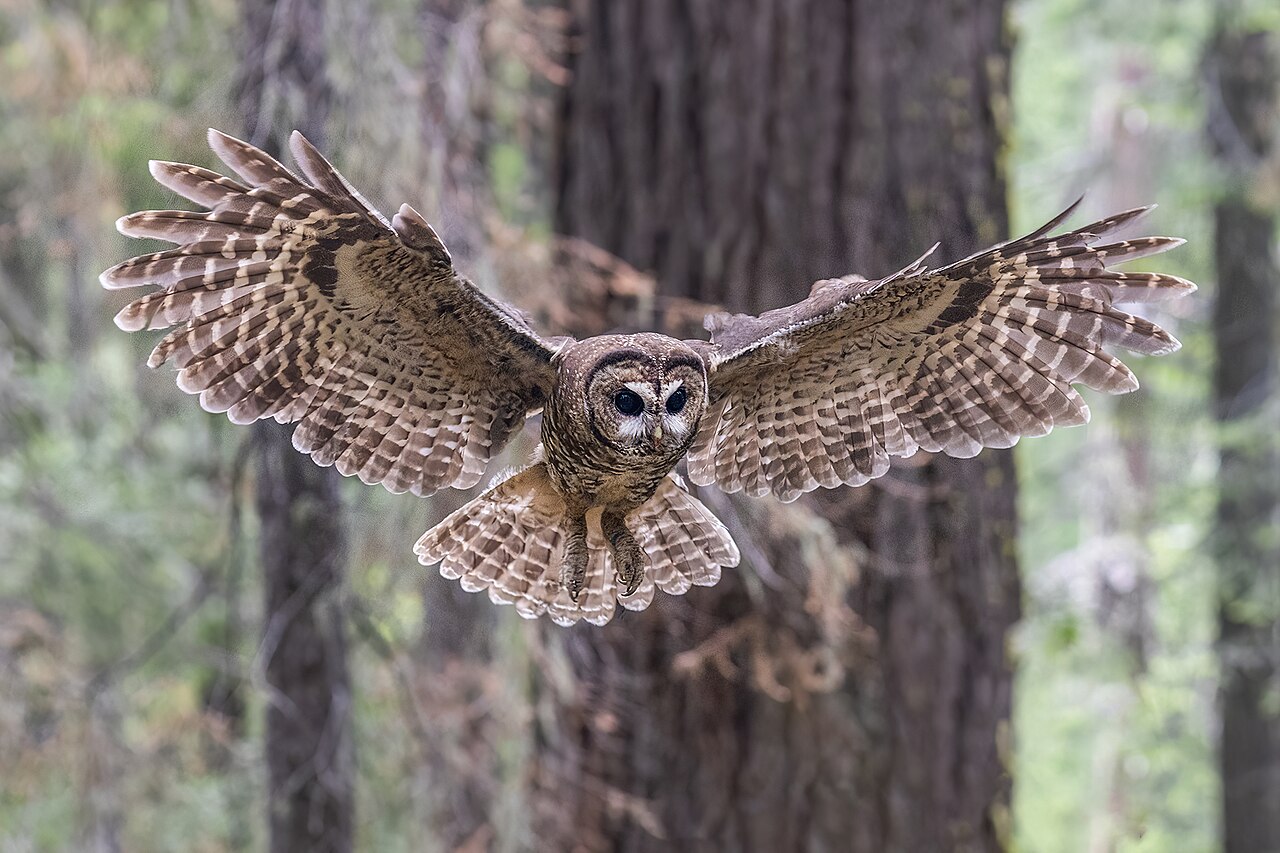
Meet the Northern Spotted Owl
Fact block — copy it for your StoryMap
Meet a quiet hunter of the deep, old forest. The northern spotted owl is a medium-sized owl with chocolate-brown feathers and round white spots on its head, back, and belly. Most owls have yellow eyes, but this one has dark, almost black eyes. It is about as long as your arm, from your shoulder to your fingertips. It has no ear tufts, just a round face.
The northern spotted owl is a medium-sized owl, roughly 16 to 19 inches long, draped in chocolate-brown feathers dotted with round white spots across its head, back, and underparts. It is the largest of three spotted owl subspecies. Unlike most owls, which have bright yellow or orange eyes, this owl has dark, nearly black eyes set in a round facial disc. Females are about 10 to 20 percent larger than males. It has no ear tufts, giving it a smooth, rounded head, and it is nocturnal, meaning it is active mainly at night.
Where It Lives
Fact block — copy it for your StoryMap
This owl lives in old-growth forests, which are forests full of very old, very tall trees. Its home stretches along the Pacific coast from southern Canada down through Washington and Oregon into northern California. That includes the old forests of Washington. The owl nests high up in holes in big old trees, or on old nests other birds left behind. It does not migrate, so it stays in the same forest all year.
The northern spotted owl makes its home in old-growth forests, woodlands packed with ancient, towering trees and a complex, layered structure. Its range follows the Pacific coast from extreme southern British Columbia, through Washington and Oregon, and into northern California. That range covers the old forests of Washington. The owl nests in cavities or on platforms high in large trees, sometimes reusing nests built by other species. It is sedentary, meaning it usually stays put year-round and only leaves if food runs short or conditions turn harsh. It needs a large amount of forest for hunting and nesting.
Why It Needs Our Help
Fact block — copy it for your StoryMap
The northern spotted owl is threatened, which means it could be in danger of disappearing. It was added to the protected list in 1990. The biggest problem is losing its home. When old-growth forests are cut down for logging, the owl loses the giant trees it needs to nest and hunt. Another owl, the barred owl, also moved in and competes for food and space. To help, people protect old forests and study the owls so this shy, dark-eyed hunter can keep living in the Pacific Northwest.
The northern spotted owl is federally threatened, a status meaning it is at risk of becoming endangered. It was listed under the Endangered Species Act on June 23, 1990. The main reason is habitat loss: logging removed much of the old-growth forest the owl depends on for nesting and for hunting prey like flying squirrels and woodrats. Washington has lost over 90 percent of its old-growth forest. A second challenge is the barred owl, a competitor that moved into the same forests and competes with the spotted owl for food and space. People are working to protect remaining old-growth forests, study owl populations, and manage these threats so this dark-eyed hunter has the wild, ancient woods it needs to survive.
Fast Facts
Fact block — copy it for your StoryMap
- Scientific name: Strix occidentalis caurina
- Size: About 16 to 19 inches long, with a wingspan around 42 inches
- Eyes: Dark, nearly black, unlike most owls' yellow eyes
- Favorite foods: Small forest mammals like flying squirrels, woodrats, voles, and mice
- Home: Old-growth forests from British Columbia through Washington and Oregon to northern California
- Status: Federally threatened; listed under the Endangered Species Act in 1990
Where these facts come from
U.S. Fish & Wildlife Service · Wikipedia · iNaturalist — real photos & sightings