Wild Files · Species File No. 09 · Bird
Marbled Murrelet
Brachyramphus marmoratus
Federally threatened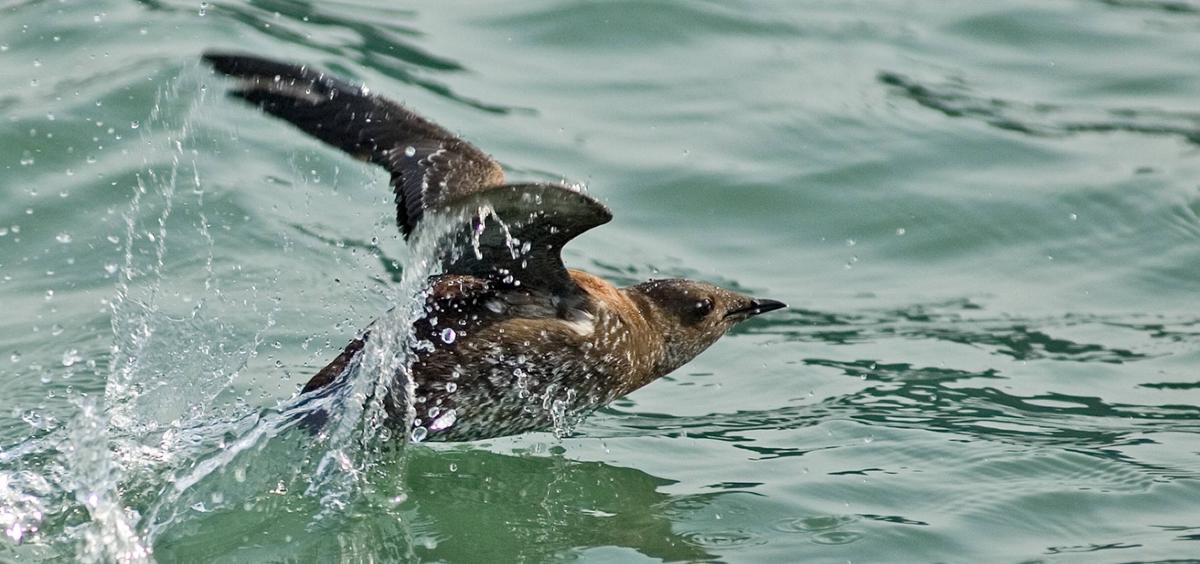
Meet the Marbled Murrelet
Fact block — copy it for your StoryMap
The marbled murrelet is a small seabird about 25 centimeters long, roughly the size of a robin. In summer its feathers turn brown and mottled, which means spotted and speckled like a forest shadow. It spends its days at sea, diving below the water to catch tiny fish. But here is the surprise: this ocean bird flies inland to lay its egg high in a giant tree. That makes it one of the strangest seabirds you can find.
The marbled murrelet is a small, chunky seabird, only about 25 centimeters long, with a slender black bill and pointed wings. Its plumage changes with the seasons. In its breeding season it wears a brown, mottled body and face that helps it blend into the forest, while in winter it is white underneath with a black crown, back, and wings. It feeds out on the ocean, diving below the surface for small fish and tiny krill both day and night. What makes it remarkable is that this seabird does not nest on a cliff or beach like most. Instead it flies inland to raise its single chick in the canopy of an ancient tree.
Where It Lives
Fact block — copy it for your StoryMap
This bird lives two lives in two places. Most of the time it floats and dives on the ocean, eating small fish like sand lance and herring. When it is time to nest, it flies inland to old forests like those near the Hoh Rain Forest in Olympic National Park. There it picks a huge, old conifer tree, a cone-bearing tree such as western hemlock, Sitka spruce, or Douglas-fir. It lays its egg high on a wide, mossy branch instead of building a normal nest.
The marbled murrelet splits its life between the sea and the forest. For feeding it stays on the ocean, diving below the surface for small fish such as sand lance, Pacific herring, and capelin. For nesting it heads inland, sometimes as far as 80 kilometers from the coast, into old-growth and mature conifer forests like those found around the Hoh Rain Forest in Olympic National Park, Washington. It chooses very large, old trees such as western hemlock, Sitka spruce, and Douglas-fir, often ones more than 32 inches across. Rather than building a nest, the bird lays a single egg high on a wide branch padded with moss or lichen, where overhead branches hide it from view.
Why It Needs Our Help
Fact block — copy it for your StoryMap
The marbled murrelet is listed as threatened, which means it could be in danger of disappearing if we are not careful. Its biggest problem is the loss of the old-growth trees it needs for nesting. When those ancient forests are cut down, the bird has fewer safe places to lay its egg. Warming ocean water and pollution make finding food harder too. The good news is that protecting old forests like the ones in Olympic National Park gives this bird the giant nesting branches it depends on.
The marbled murrelet is protected as a threatened species under the Endangered Species Act, and the IUCN, a group that tracks wildlife worldwide, lists it as endangered. Its numbers have dropped mainly because of the loss of nesting habitat in old-growth trees, since this bird depends on very large, ancient conifers to raise its young. Warming ocean temperatures and pollution also make it harder to find the small fish it eats, and boat traffic and commercial fishing add to the pressure. Because the bird needs both healthy seas and ancient forests, protecting old-growth places such as Olympic National Park is one of the most important ways to keep the marbled murrelet around for the future.
Fast Facts
Fact block — copy it for your StoryMap
- Scientific name: Brachyramphus marmoratus
- Size: about 25 centimeters long, a small seabird
- Food: small fish like sand lance, Pacific herring, and capelin, plus krill
- Nest: a single egg laid high on a wide, mossy branch of an old conifer tree
- Range: Pacific coast from Alaska south to central California, nesting up to 80 km inland
- Status: federally threatened under the Endangered Species Act
Where these facts come from
U.S. Fish & Wildlife Service · Wikipedia · iNaturalist — real photos & sightings