Wild Files · Species File No. 30 · Fish
Coho Salmon
Oncorhynchus kisutch
Meet the Coho Salmon
Fact block — copy it for your StoryMap
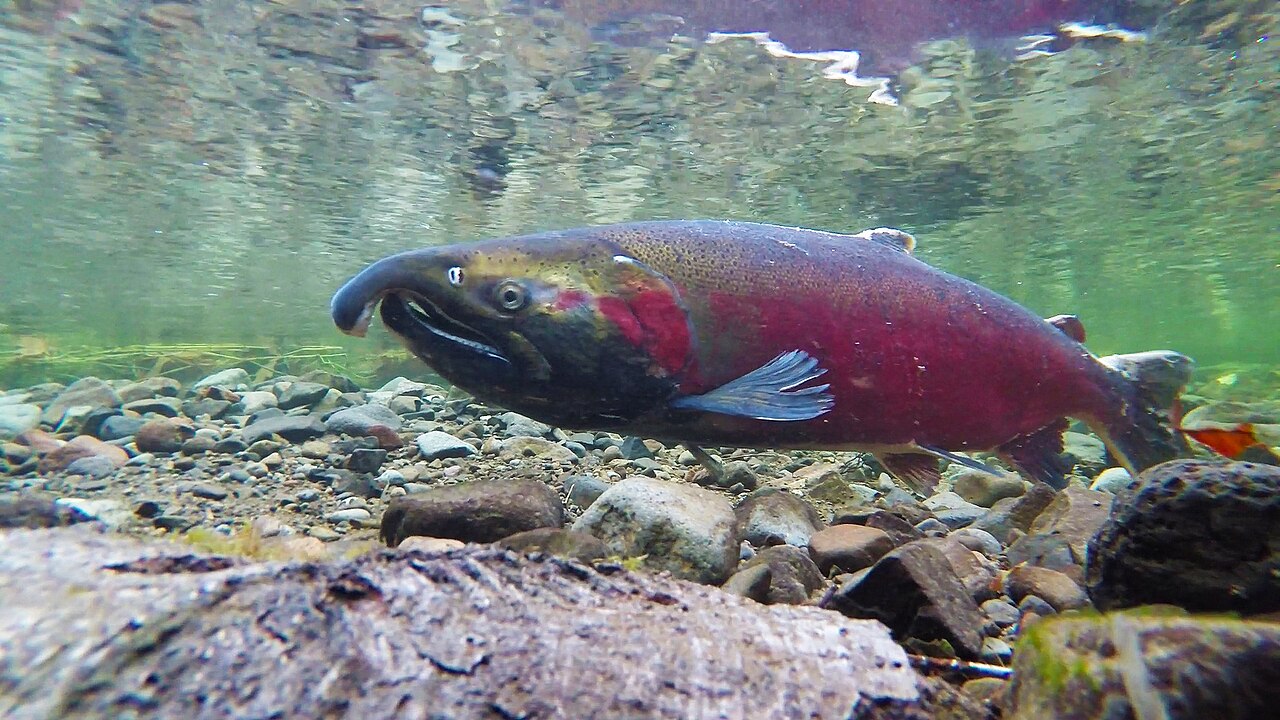
The coho salmon is a fish with a big secret: it changes color during its life. In the ocean it has silver sides and a dark-blue back, which is why people call it the silver salmon. When it swims back to a river to lay eggs, its sides turn bright red and its head turns greenish-blue.
Coho are medium-sized fish, about 2 to 2 and a half feet long. Most weigh around 8 to 12 pounds, about as heavy as a big house cat.
The coho salmon is a shape-shifter. Out in the Pacific Ocean it wears silver sides and a dark-blue, spotted back, which earned it the nickname silver salmon. When it returns to freshwater to spawn (lay eggs), its body transforms: the sides flush bright red and the head and back turn a bluish-green. This dramatic costume change happens as the fish gets ready to reproduce.
Coho are medium-sized salmon, usually about 2 to 2 and a half feet long and weighing roughly 8 to 12 pounds. They are anadromous, meaning they are born in freshwater, grow up in the ocean, and travel back to freshwater to spawn.
Where It Lives
Fact block — copy it for your StoryMap
Coho salmon live along the West Coast, in rivers and streams from California all the way north to Alaska. The cold, clean rivers around the Hoh Rain Forest are part of this home range. Coho need cold, clean water to lay their eggs.
Young coho hide in calm side channels where they can find food and stay safe from animals that want to eat them. Adults spend about a year and a half feeding in the Pacific Ocean before swimming home.
Coho salmon range along the Pacific coast in rivers and streams from California north to Alaska, so the cold, clear rivers flowing out of the Olympic National Park area, including the Hoh Rain Forest, fall within their home range. To reproduce, coho need cold, clean freshwater streams with stable gravel bottoms.
Their lives cross two very different worlds. Juvenile coho rear in rivers and streams for at least one summer, sheltering in side channels and floodplains where they can find food and hide from predators. Then they migrate to saltwater, feeding and growing in the ocean for about a year and a half before returning to freshwater to spawn.
Its Role in the Ecosystem
Fact block — copy it for your StoryMap
Coho are a key link in the food web. Young coho eat tiny water creatures and insects that fall into the stream. In the ocean, bigger coho mostly eat other fish. Animals like sea lions and seals eat coho, too.
Coho spawn in river gravels, and after spawning the adults die.
Coho salmon sit right in the middle of the food web. As young fish in freshwater, they eat plankton, aquatic insects like midge larvae, and land insects that drop into the water. Once in the ocean, they switch to eating mostly fish. In turn, coho are food for predators such as sea lions and harbor seals, so they pass energy up the food chain.
Coho spawn in river gravels, and afterward the adults stop eating and die, a pattern called semelparity.
Fast Facts
Fact block — copy it for your StoryMap
- Scientific name: Oncorhynchus kisutch
- Nickname: the silver salmon, for its ocean-silver sides
- Size: about 2 to 2 and a half feet long, roughly 8 to 12 pounds
- Life journey: anadromous, born in freshwater, grows in the ocean, returns to spawn
- Range: West Coast rivers and the Pacific Ocean, from California to Alaska
- Spawning: lays eggs in stream gravels, then the adults die after spawning
Where these facts come from
NOAA Fisheries · Wikipedia · iNaturalist — real photos & sightings