Wild Files · Species File No. 04 · Mammal
Black-tailed Deer
Odocoileus hemionus columbianus
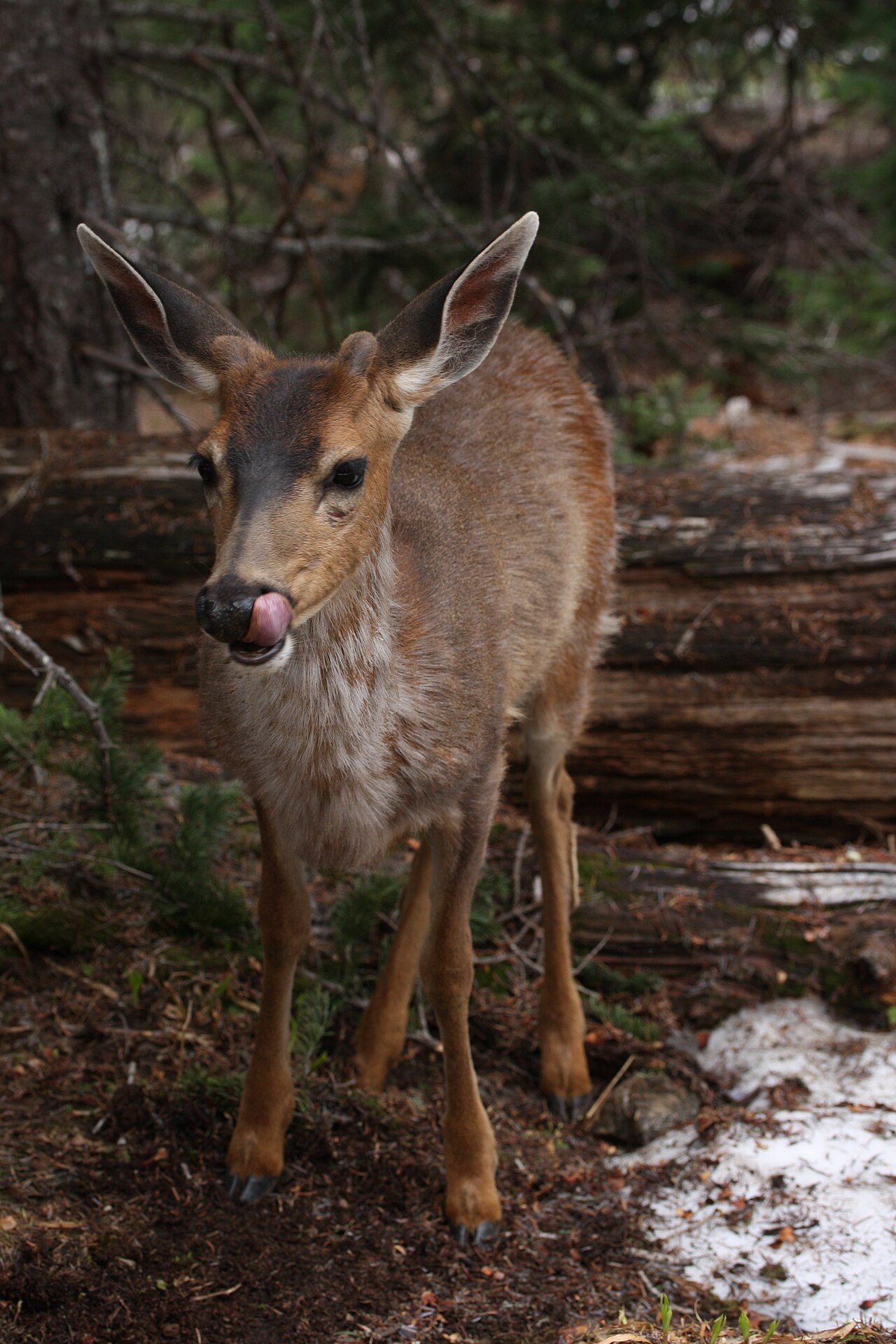
Meet the Black-tailed Deer
Fact block — copy it for your StoryMap
The black-tailed deer gets its name from its dark tail, which makes it easy to tell apart from its bigger cousin, the mule deer. In fact, it is a subspecies of mule deer — that means a special local type of the same animal. These deer have amazing senses. Their big ears can swivel in two different directions at once, listening for danger. If you want to spot one, look at dawn or dusk, when deer are most active.
The black-tailed deer is a coastal subspecies of mule deer (Odocoileus hemionus), named for its dark tail — a quick field mark that separates it from the larger, lighter-colored mule deer found inland. The split runs deeper than looks: scientists found that the mitochondrial DNA of black-tailed deer differs from mule deer DNA by 6–8 percent, one of the biggest divergences measured within any mammal species. Adults weigh roughly 77–144 pounds in California and up to about 96–164 pounds in Alaska. Sharp eyes, a keen nose, and large ears that move independently of each other help these deer pick up any sign of danger, and they are most active at dawn and dusk.
Where It Lives
Fact block — copy it for your StoryMap
Black-tailed deer live along the Pacific coast, from California all the way north to Alaska. That includes the forests of Olympic National Park and the Hoh Rain Forest. These deer like forest edges best, where shady trees meet open, brushy spots full of food. In the Hoh, they browse the understory — the layer of ferns, shrubs, and young plants growing beneath the giant trees. Walk quietly at dawn or dusk and you might spot one stepping out of the greenery.
This deer is a Pacific coast specialist. Its range hugs the western edge of North America from Santa Barbara County, California, north through Oregon and Washington, along coastal British Columbia, and into southeastern Alaska — which puts the Olympic Peninsula and the Hoh Rain Forest right in the heart of black-tailed deer country. These deer thrive on the edge of the forest, where dense cover for hiding meets underbrush and grassy openings for feeding. In the Hoh, that means the understory: the shaded layer of salal, red huckleberry, and deer fern beneath the towering trees, all of which are on the deer's menu. They live on the forest floor, not in the canopy, and move most at dawn and dusk.
A Key Link in the Food Web
Fact block — copy it for your StoryMap
A black-tailed deer is a browser, which means it eats leaves, twigs, and shrubs instead of just grass. In spring and summer it munches grasses, blackberries, and salmonberry. In winter it switches to tougher food like Douglas fir, salal, and even lichens. Deer are food for predators, too. In Alaska, their close cousins are the main meal of a rare wolf. Even dropped antlers matter — on the forest floor, they give other animals calcium and nutrients. Without deer, the rainforest would lose a key link in its food web.
Black-tailed deer are common browsers of the rainforest understory, and their menu shifts with the seasons. From late spring through fall they feed on grasses, blackberries, fireweed, salmonberry, salal, and maple. In winter they switch to tougher fare: Douglas fir, western red cedar, red huckleberry, deer fern, and even lichens. The deer are a link upward in the food web, too. In Southeast Alaska, the Sitka black-tailed deer — this deer's northern cousin — is the primary prey of the rare Alexander Archipelago wolf, so the predator's survival depends on healthy deer populations. Even shed antlers have a job: on the forest floor, they provide calcium and other nutrients to other forest inhabitants. Remove the deer, and predators and forest recyclers alike would lose out.
Fast Facts
Fact block — copy it for your StoryMap
- Scientific name: Odocoileus hemionus columbianus — a subspecies of mule deer
- Size: Adults weigh roughly 77 to 164 pounds, smallest in California and largest in Alaska
- Range: Pacific coast of North America, from California north to Alaska — including western Washington
- Diet: A browser — salal, red huckleberry, deer fern, berries, and grasses, plus Douglas fir and lichens in winter
- Fawns: Born in late May and June, often as twins; newborns have almost no scent for their first week, which helps them stay hidden
- Best viewing: Dawn and dusk, when these deer are most active
Where these facts come from
U.S. Fish & Wildlife Service · Wikipedia · iNaturalist — real photos & sightings