Wild Files: El Yunque · Species File No. 18 · Plant
Wild Orchids
Orchidaceae spp.
Meet the Wild Orchids
Fact block — copy it for your StoryMap
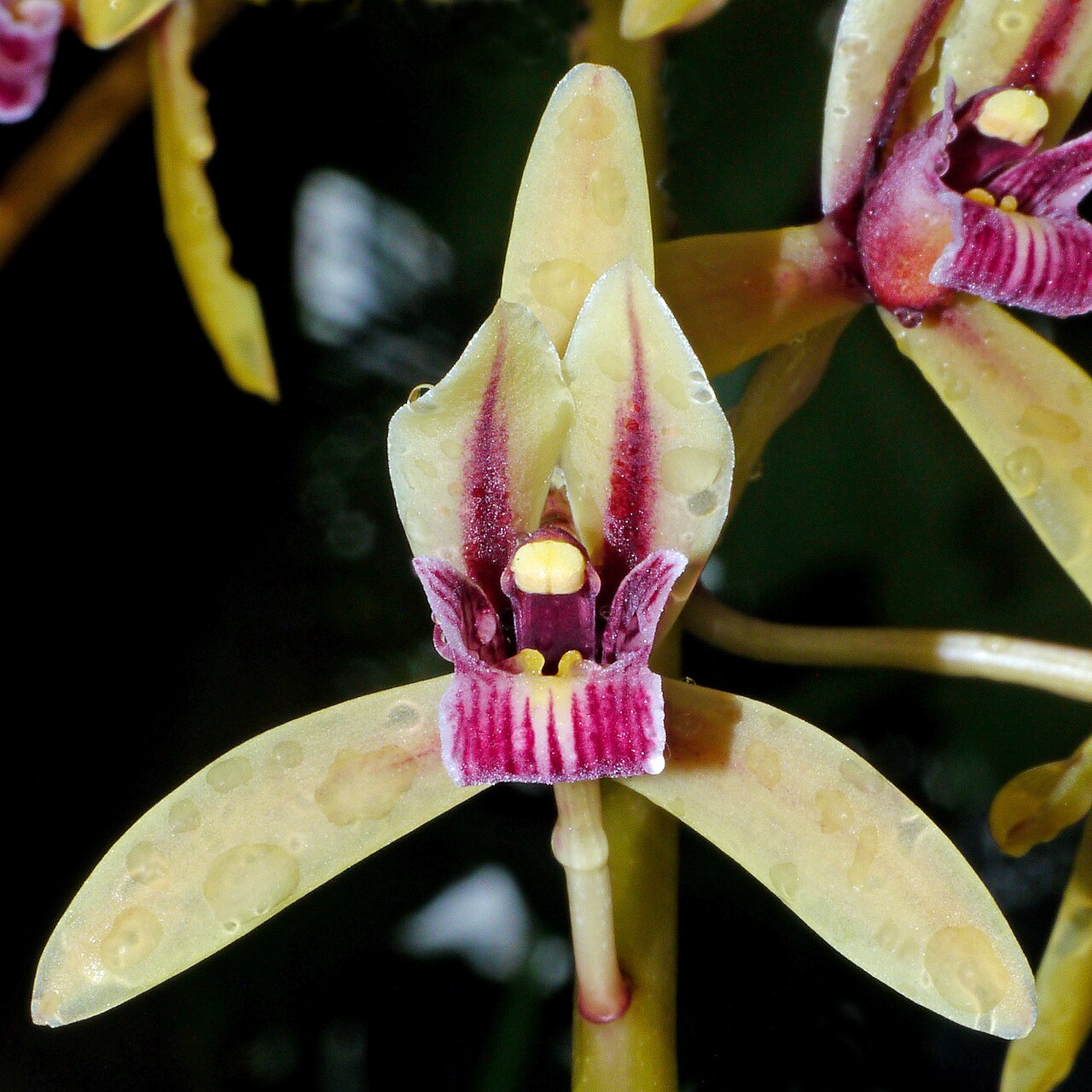
Orchids are flowers with a clever trick. One petal grows into a special shape called a lip, like a tiny landing pad for bugs. Inside the flower, the parts that make and catch pollen are joined into one little post called a column. Orchids belong to one of the biggest plant families on Earth, with around 28,000 kinds of orchid in all. That is a lot of cousins.
Orchids make up one of the two largest families of flowering plants, with about 28,000 species in roughly 700 groups called genera. What makes an orchid an orchid? Its flower has bilateral symmetry, meaning the left and right halves mirror each other like your face. The middle petal is reshaped into a showy lip, or labellum, that works as a landing stage, or sometimes even a trap, for visiting insects. The pollen-making and seed-making parts are fused together into a single structure called the column. These features set orchids apart from almost every other flower you will meet.
Where Wild Orchids Live
Fact block — copy it for your StoryMap
Orchids grow almost everywhere. They live on every continent except cold, icy Antarctica, and the most kinds grow in warm, wet tropical places, like rainforests. Many orchids do not grow in the ground at all. Instead they live high up on tree branches, perched in the sunlight. A plant that grows on another plant like this is called an epiphyte. Some orchids grow on rocks, and some grow in soil too.
Orchids are cosmopolitan, which means they are spread across the globe, living in many habitats on every continent except Antarctica. Even so, the richest variety of orchids by far is found in the tropics, the warm and rainy band around the middle of the planet where rainforests grow. Many tropical orchids are epiphytes: rather than rooting in soil, they perch on the trunks and branches of trees, soaking up light and moisture in the air. Others grow in the ground as terrestrial plants, or cling to bare rock as lithophytes, fitting themselves into almost any niche they can find.
A Tiny Partnership That Keeps Orchids Going
Fact block — copy it for your StoryMap
Orchids have some of the smallest seeds in the world, almost like dust. A seed that tiny carries no packed lunch inside it. So to grow, most orchid seeds team up with a helper: a fungus, which is the same family as mushrooms. The fungus feeds the baby orchid until it is big enough to make its own food. Orchids also need insects to carry their pollen. The flower's special lip helps guide a visiting bug to exactly the right spot.
Orchid seeds are extremely small, nearly like specks of dust, and most lack the built-in food supply that bigger seeds use to sprout. To survive, the seeds form a partnership with mycorrhizal fungi in the soil or bark. Early on, the young orchid is mycoheterotrophic, meaning it gets its food from the fungus instead of from sunlight, until it grows enough to feed itself. Pollination is just as clever. Orchids package their pollen into sticky masses called pollinia, and the flower's lip acts as a guide that steers insects to pick them up. Some orchids even trick their pollinators by mimicking other insects or false rewards, showing how tightly these plants depend on their living neighbors.
Fast Facts
Fact block — copy it for your StoryMap
- Family size: Orchidaceae has about 28,000 species, one of the two largest flowering plant families.
- Signature feature: a modified middle petal called the lip, or labellum, that acts as a landing stage for insects.
- Where they grow: on every continent except Antarctica, with the greatest variety in the tropics.
- Living high up: many tropical orchids are epiphytes, growing perched on tree branches instead of in soil.
- Tiny seeds, big helper: orchid seeds are dust-sized and rely on mycorrhizal fungi to grow.
- Protected plants: nearly all orchids are listed on CITES Appendix II to guard against over-collection.
Where these facts come from
USDA Forest Service · Wikipedia · iNaturalist — real photos & sightings