Wild Files: El Yunque · Species File No. 13 · Tree
Tabonuco
Dacryodes excelsa
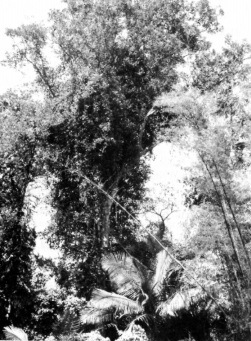
Meet the Tabonuco
Fact block — copy it for your StoryMap
The tabonuco is a big rainforest tree from Puerto Rico. Its scientific name is Dacryodes excelsa, but everyone calls it tabonuco. It has smooth gray bark and wide, low ridges at its base called buttresses that help hold it up. When the bark is wounded, the tree oozes a clear, sticky resin that smells nice and can burn like a candle. Long ago, early settlers used this resin to make candles and torches.
The tabonuco (Dacryodes excelsa) is one of the most important trees in Puerto Rico's mountain rainforest. You can recognize it by its smooth gray bark, its straight columnar trunk, its broad low buttresses (winglike ridges at the base that brace the tree), and its leaves made of five to seven fragrant, dark-green leaflets. Its most surprising feature is hidden inside: when the trunk is wounded, the tabonuco releases a clear, fragrant, flammable resin that hardens and turns white in the air. People once burned this resin for candles, torches, and incense, used it to caulk boats, and even used it as medicine. That is why the tree is also called gommier or candlewood.
Where It Lives
Fact block — copy it for your StoryMap
Tabonuco grows all over Puerto Rico in the mountains, from about 660 to 2,800 feet high. In the Luquillo Mountains, where El Yunque is, it is so common that scientists named a whole forest zone after it: the tabonuco forest. Tabonuco trees like to stand together on the upper slopes and ridges. The tree also lives outside Puerto Rico, on other Caribbean islands in the Lesser Antilles like Dominica and Guadeloupe.
Tabonuco is native to Puerto Rico, where it grows in the mountains at elevations from about 200 to 900 meters (660 to 2,800 feet). In the Luquillo Mountains, the home of El Yunque, it is so dominant that the lower-mountain forest is named the tabonuco forest after it. On favorable sites it can make up about 35 percent of the forest's basal area and most of its timber volume. Trees tend to gather on upper slopes and ridges. Tabonuco is not found only in Puerto Rico, though, it also grows on several islands of the Lesser Antilles, including St. Kitts, Montserrat, Guadeloupe, Dominica, Martinique, St. Lucia, St. Vincent, and Grenada.
Its Job in the Forest
Fact block — copy it for your StoryMap
The tabonuco is a giant of its forest, and it feeds and shelters its neighbors. Its fruit is a small one-seeded drupe (a fruit with one seed inside, like a tiny plum). The endangered Puerto Rican parrot eats tabonuco seeds, and other animals do too. Tabonuco also has a clever trick against storms: nearby trees join their roots together underground, like friends holding hands. This root grafting helps a group of trees stand strong when hurricanes blow through the mountains.
As the dominant tree of its forest, the tabonuco shapes life all around it. It is dioecious, meaning male and female flowers grow on separate trees, and it flowers most from May to November, dropping its small one-seeded fruits (called drupes) from October to December. The endangered Puerto Rican parrot feeds on tabonuco seeds, and other animals eat the seeds as well. The tabonuco is also famous for surviving hurricanes, the central climate story of these mountains. Neighboring trees fuse their roots underground through root grafting, so that 10 to 20 trees can share one connected root system. This gives them stronger anchorage against hurricane-force winds. Many trees still lose branches or fall in big storms, but as a group, tabonucos have thrived in the windy West Indies for a very long time, some are estimated to be up to 400 years old.
Fast Facts
Fact block — copy it for your StoryMap
- Scientific name: Dacryodes excelsa, known in Spanish as tabonuco (also called gommier or candlewood)
- Height: mature trees can reach about 35 meters (115 feet) tall
- Lifespan: large trees are estimated to be up to 400 years old
- Resin: oozes a fragrant, flammable resin once used for candles, torches, incense, and caulking boats
- Storm survivor: 10 to 20 trees graft their roots together for better anchorage against hurricanes
- Range: native to Puerto Rico's mountains (660 to 2,800 feet) and several Lesser Antilles islands
Where these facts come from
USDA Forest Service · Wikipedia · iNaturalist — real photos & sightings