Wild Files: El Yunque · Species File No. 06 · Bird
Puerto Rican Tody
Todus mexicanus
Found only here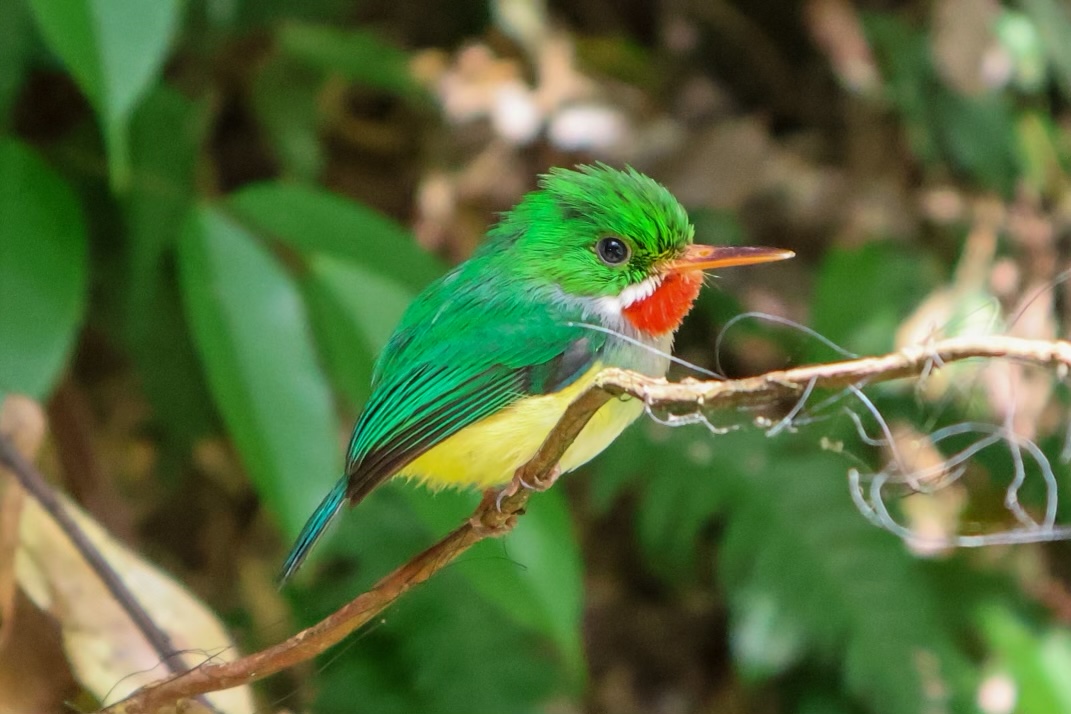
Meet the Puerto Rican Tody
Fact block — copy it for your StoryMap
The Puerto Rican tody is a tiny green bird. People in Puerto Rico call it the San Pedrito, which means "little Saint Peter." Its back is shiny emerald green, like a leaf in the sun. Under its chin is a patch of bright red. It is only about 11 centimeters long, smaller than your hand. It weighs about as much as five paper clips. Its long, broad bill can be as long as its head, or even longer.
The Puerto Rican tody is one of the smallest birds you can imagine. Most people on the island know it by its Spanish name, San Pedrito ("little Saint Peter"). Some also call it the medio peso. It measures only about 11 centimeters long and weighs just 5 to 6 grams, lighter than a few coins. Its upperparts are a glossy emerald green, and its belly is white with pale-yellow sides. A vivid red throat sits below a long, broad bill that can be as long as its head, or even longer. One handy clue tells males from females: males have gray eyes, while females have white eyes.
Where It Lives
Fact block — copy it for your StoryMap
The San Pedrito lives only on the island of Puerto Rico. You can find it in forests all over the island. It likes damp, leafy forests high up in the mountains best. It also lives in places with thick, tangled bushes, like the Guánica Forest in the south. Each pair of todies keeps its own little patch of forest as a home territory.
The Puerto Rican tody is found across Puerto Rico's main island and nowhere else in the world. It lives mostly in forested areas, and it especially favors high-altitude damp forests. It also thrives in dense thickets, such as the Guánica Forest in the south. A breeding pair defends its own home territory of about 0.7 hectares (roughly 1.8 acres) in lowland forest. Higher up the mountains, territories can grow to about two hectares. Wherever it settles, this bird stays close to the leafy cover it uses for hunting.
An Endemic Bird That Needs Our Care
Fact block — copy it for your StoryMap
The San Pedrito is endemic to Puerto Rico. Endemic means it lives naturally in only one place on Earth and nowhere else. If something happened to it here, it would be gone from the whole world. Right now scientists list it as a common bird, which is good news. But island animals can be in danger from hunters that people brought in, like the mongoose, which raids tody nests. Cutting down forests can hurt it too, so protecting its home helps protect the bird.
The Puerto Rican tody is endemic to Puerto Rico, meaning it lives nowhere else on the planet. That makes an island species special and also fragile: there is no backup population somewhere else, so the whole world's todies depend on this one island. The good news is that the IUCN, a group that tracks wildlife, lists the tody as Least Concern, and it remains a common bird. Still, island species face real risks. Introduced Indian mongooses prey on tody nests. Habitat loss, including the change from shaded coffee farms to sun-grown coffee, removes the forest cover it needs. Caring for Puerto Rico's forests is how we keep the San Pedrito safe.
Fast Facts
Fact block — copy it for your StoryMap
- Spanish name: San Pedrito ("little Saint Peter")
- Scientific name: Todus mexicanus
- Size: about 11 cm long, weighing only 5 to 6 grams
- Colors: emerald-green back, white belly, bright red throat
- Diet: mostly insects (about 86%) like crickets, grasshoppers, flies, and beetles
- Where it lives: endemic to Puerto Rico, found nowhere else on Earth
Where these facts come from
U.S. Fish & Wildlife Service · Wikipedia · iNaturalist — real photos & sightings