Wild Files: El Yunque · Species File No. 22 · Invertebrate
Puerto Rican Land Snail
Caracolus caracolla
Meet the Puerto Rican Land Snail
Fact block — copy it for your StoryMap
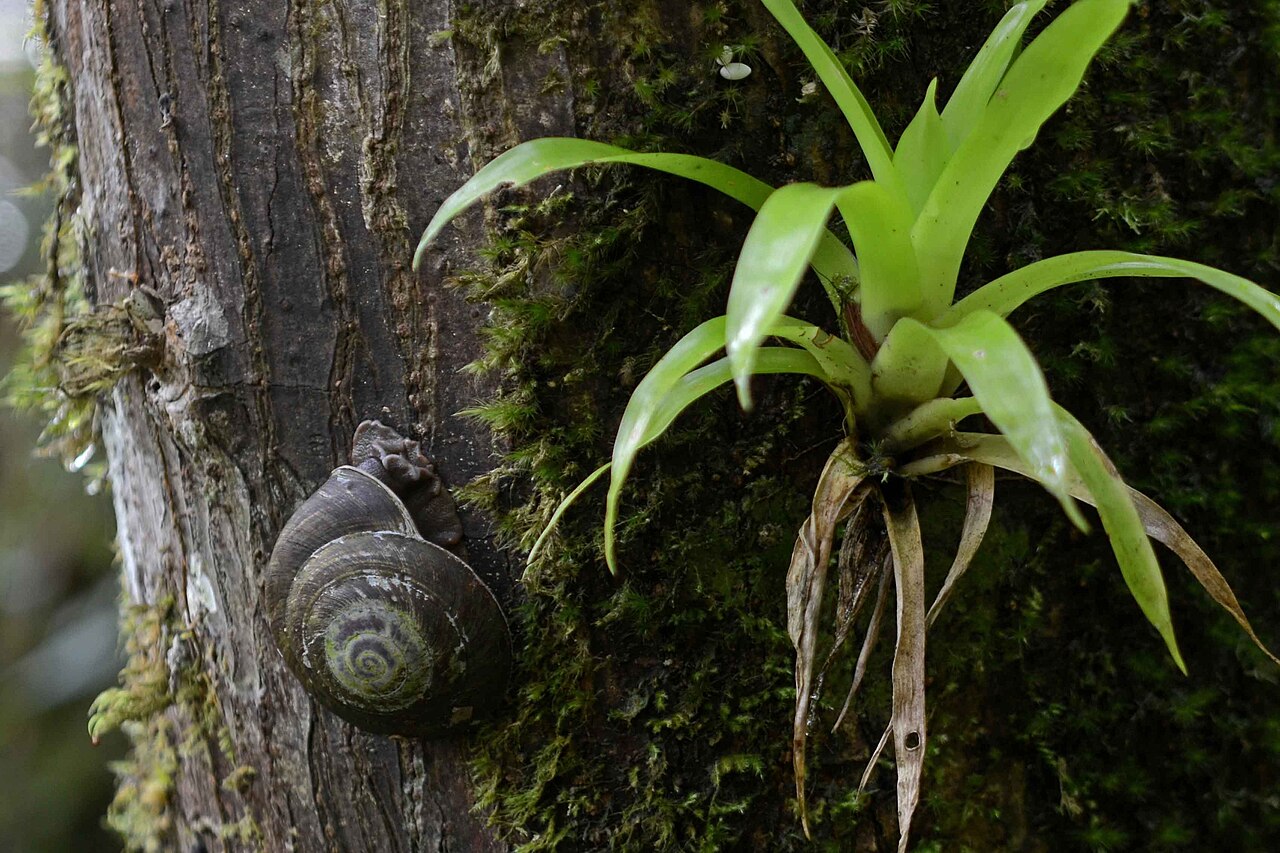
The Puerto Rican land snail is a big snail that lives in the rainforest. Its scientific name is Caracolus caracolla. It has a wide, coiled shell shaped like a flattened wheel. The shell is about 25 millimeters across, around the size of a quarter, and can grow to about 35 millimeters. This snail breathes air and crawls slowly over the ground and up tree trunks. It comes out mostly at night.
The Puerto Rican land snail, Caracolus caracolla, is one of the larger snails of the rainforest floor and tree trunks. It is an air-breathing land snail in the family Solaropsidae. Its coiled shell is heliciform, meaning it spirals out into a wide, flattened disc rather than a tall spire. The shell averages about 25 millimeters across and can reach roughly 35 millimeters. Like other land snails in this forest, it is most active at night and is protected by a thick shell. Scientists who study Puerto Rico's snails call them gastropods, the group that includes snails and slugs.
Where It Lives
Fact block — copy it for your StoryMap
This snail lives in El Yunque, a rainforest in northeastern Puerto Rico. El Yunque has different kinds of forest at different heights on the mountains. The lowest is the tabonuco forest, named for a big tree. Higher up are the palo colorado forest, the palm forest, and the misty dwarf forest near the peaks. Scientists found the most Puerto Rican land snails low down in the tabonuco forest. You might spot one on damp leaves or a tree trunk.
The Puerto Rican land snail lives in the Luquillo Mountains of northeastern Puerto Rico, the home of El Yunque National Forest. These mountains rise from the coast to about 1,338 meters, and the forest changes as you climb. Tabonuco forest grows up to about 600 meters, palo colorado forest from 600 to 900 meters, and dwarf or elfin forest on the windy peaks above that. Sierra palm forest grows in wet, steep patches at all heights. Surveys found this snail throughout the range but most abundant at the lowest elevations, in the tabonuco zone. Because these snails dry out easily, they stay where the air is humid, foraging on leaf litter and on living plants.
Its Job in the Rainforest
Fact block — copy it for your StoryMap
This snail is a recycler. Scientists call it a grazer, which means it scrapes up tiny food from surfaces. It eats algae, fungus, and bits of rotting leaves on the ground and on trees. By eating dead and decaying material, it helps break it down and return nutrients to the forest. Snails like this also need calcium to build their shells, and they get it from the rich forest litter. Storms shape their world too. Big hurricanes knock down leaves and branches, and scientists study how the forest and its snails recover.
The Puerto Rican land snail is part of the forest's clean-up crew. Scientists classify it as a grazer, an animal that scrapes algae, fungi, and decaying plant material from leaf litter and from the surfaces of live and dead wood. Researchers describe the forest's land snails as potentially keystone heterotrophs, meaning animals that may have an outsized role in breaking down material and moving energy through the food web. Snails need minerals like calcium to grow their shells, and they tend to be more abundant where the litter is richest in nutrients. Puerto Rico is hit often by hurricanes, such as Hugo and Georges, which strip leaves, topple trees, and trigger landslides. Studying snails before and after these storms helps scientists understand how rainforest life recovers from disturbance.
Fast Facts
Fact block — copy it for your StoryMap
- Scientific name: Caracolus caracolla
- Shell width: about 25 mm on average, up to roughly 35 mm
- Shell shape: wide and coiled like a flattened disc
- Home: El Yunque and the Luquillo Mountains of northeastern Puerto Rico
- Eats: algae, fungi, and rotting plant material it grazes from litter and trees
- Active: mostly at night, when the air is humid
Where these facts come from
USDA Forest Service · Wikipedia · iNaturalist — real photos & sightings