Wild Files: El Yunque · Species File No. 12 · Reptile
Puerto Rican Giant Anole
Anolis cuvieri
Found only here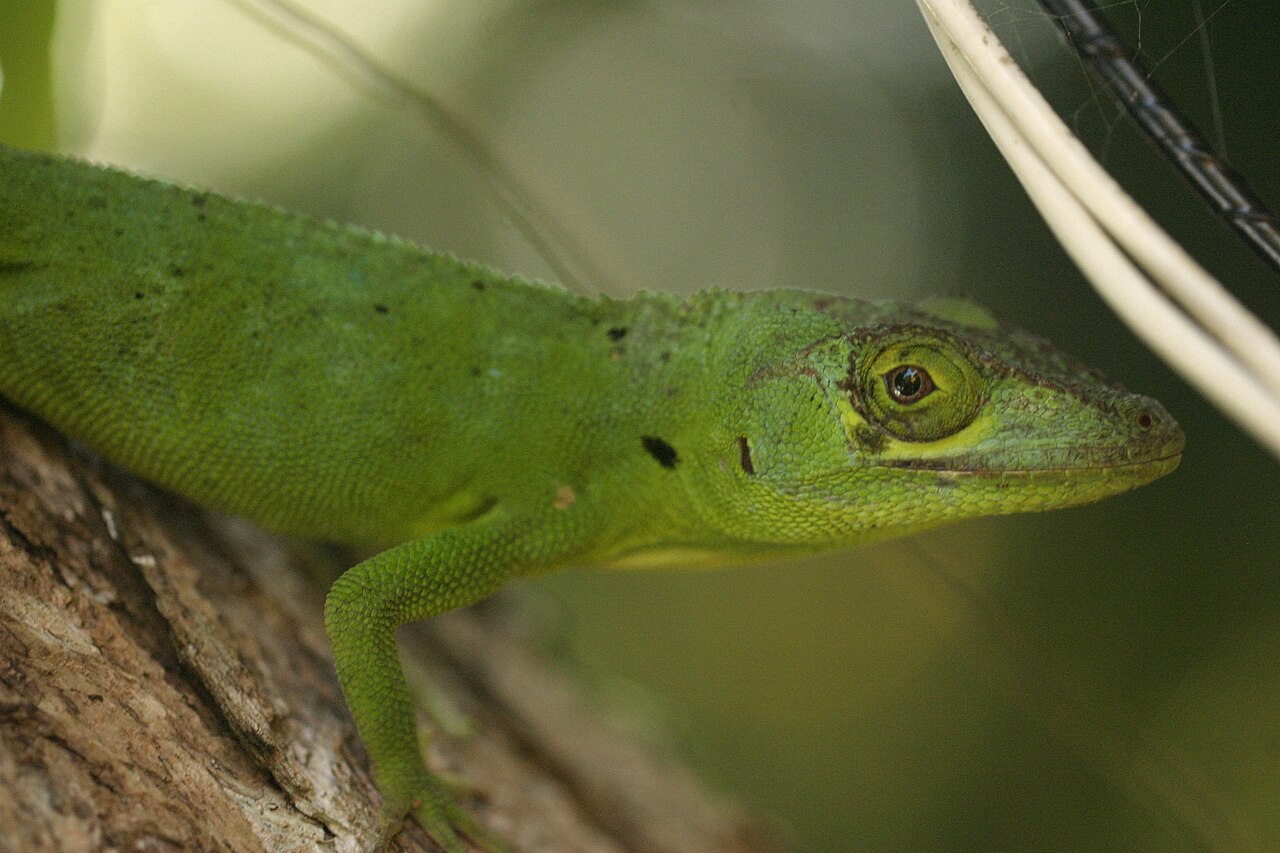
Meet the Puerto Rican Giant Anole
Fact block — copy it for your StoryMap
The Puerto Rican giant anole is a very big anole lizard. Scientists call it a crown giant. It lives in the crown, or very top, of tall trees. In Spanish, people call it the lagarto verde, or green lizard. Another name is lagarto chipojo. Grown-ups are bright green. A bumpy ridge of raised scales runs down their backs. They live way up high in the treetops, so they are hard to spot. Catching even one glimpse of this shy green giant feels like winning a prize.
Meet the Puerto Rican giant anole, known in Spanish as the lagarto verde (green lizard) and the lagarto chipojo. It belongs to a group of anoles called crown giants. These are large species that live in the uppermost canopy of tall trees. Adults can reach about 13 centimeters (5 inches) from snout to the base of the tail. They are mostly bright green, with a serrated ridge of raised scales along the back. On the tail is a crest that they can raise. Males may show sky-blue on the head. Both males and females have a dewlap, a flap of skin under the throat. Males send signals by extending and folding back the dewlap while bobbing their heads. Because these lizards stay high in the canopy, people rarely see them. That makes a sighting feel genuinely special.
Where It Lives
Fact block — copy it for your StoryMap
This anole lives only in Puerto Rico. Its home is wet forests full of tall trees. It can live from near the sea all the way up into the mountains. Grown-up lizards stay near the very top of the forest, in the canopy. The canopy is the leafy roof made by the highest branches. They like big palm trees and fig trees. Baby anoles live lower down, near the bottoms of trees or on the ground. These lizards live in El Yunque National Forest. They also live in the forest at Toro Negro.
The Puerto Rican giant anole is found only in Puerto Rico, in wet forests with plenty of large trees. It lives from sea level up to nearly 1,200 meters in the mountains. Adults spend their time in the uppermost canopy, the leafy top layer of the forest. They favor tall palms and fig trees and rarely come down to the ground. Younger lizards stay lower, near tree trunks or on the forest floor. The species lives in El Yunque National Forest and is common in the Toro Negro State Forest. It prefers damp forest over drier areas. Because it depends on the forest canopy, anything that removes the treetops is a threat. Even so, it remains abundant in a number of protected areas.
Endemic: A Lizard Found Nowhere Else
Fact block — copy it for your StoryMap
This lizard is endemic to Puerto Rico. Endemic means it lives in one place on Earth and nowhere else. Long ago, when many forests were cut down, this anole almost disappeared. Later, farms were left to grow wild again. The forests came back, and so did the lizard. Today scientists say it is doing okay. But an island animal needs special care. If it vanishes here, it is gone for good.
The Puerto Rican giant anole is endemic to Puerto Rico, meaning it lives on this island and nowhere else in the world. Endemic island species need extra protection. Because they exist in only one place, losing them here means losing them everywhere. In the early 1900s, heavy deforestation pushed this anole close to extinction. When farmland was abandoned in the late 1950s, the forests slowly grew back. The lizard made a remarkable recovery. Scientists now list it as a species of Least Concern with a stable population. That hopeful comeback only holds if its forests stay healthy and protected.
Fast Facts
Fact block — copy it for your StoryMap
- Scientific name: Anolis cuvieri
- Spanish names: lagarto verde, lagarto chipojo
- Found only in: Puerto Rico (endemic)
- Home: treetop canopy of wet forests, especially tall palms and fig trees
- Eats: insects, plus other anoles, small birds, large snails, and sometimes fruit
- Status: Least Concern; recovered after nearly disappearing during past deforestation
Where these facts come from
IUCN Red List · Wikipedia · iNaturalist — real photos & sightings