Wild Files: El Yunque · Species File No. 11 · Reptile
Puerto Rican Crested Anole
Anolis cristatellus
Meet the Puerto Rican Crested Anole
Fact block — copy it for your StoryMap
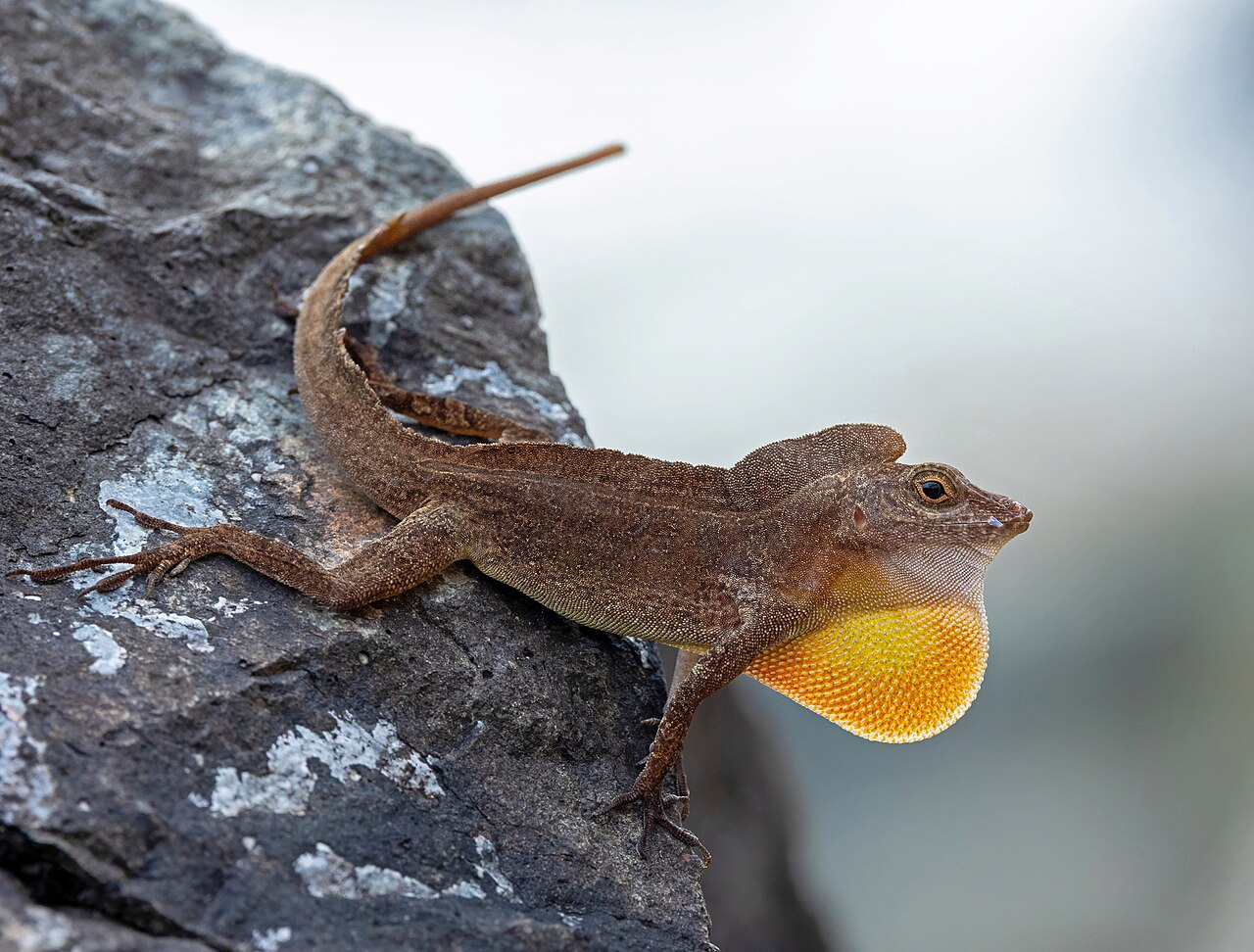
The Puerto Rican crested anole is a small, stocky lizard you can spot all over Puerto Rico. People here call it the lagartijo común, which means common anole. Males have a flap of skin under the chin called a dewlap that they puff out like a tiny flag. It is mustard or greenish-yellow with an orange edge. Males also do quick push-ups to show off and warn other males to stay away.
The Puerto Rican crested anole (Anolis cristatellus) is one of the most common lizards on the island, and locals know it as the lagartijo común, or common anole. It is stocky and muscular, usually bronze to greenish-grey, and it can change color from light grey to reddish-brown or dark black. Males grow larger than females and carry a caudal crest — a permanently raised ridge along the tail supported by bony extensions of the tail bones. To communicate, a male inflates his yellow-and-orange dewlap (a flap of throat skin) and pumps out push-ups to attract mates or intimidate rivals.
Where It Lives
Fact block — copy it for your StoryMap
This lizard lives all across Puerto Rico, from the seashore up into the hills. You can find it in big cities like San Juan and Ponce, and also in El Yunque National Forest, where up to seven other kinds of anole share the trees. It usually rests on the bottom couple of meters of a tree trunk. From there it hops down to the ground to hunt for food and to lay its eggs.
The Puerto Rican crested anole lives throughout Puerto Rico, from sea level up into the mountains, though it is not found at the island's very highest elevations. It thrives in cities such as San Juan, Mayagüez, Ponce, and Arecibo, and it lives in El Yunque National Forest alongside as many as seven other anole species. Scientists call it a ground-trunk anole because it spends most of its time on the lowest two meters of tree trunks, then drops to the ground to forage and to lay its eggs. It has even been recorded high in the mountains, around 980 meters in Los Tres Picachos State Forest.
Its Job in the Rainforest
Fact block — copy it for your StoryMap
The crested anole is a hunter and a snack at the same time. It eats small animals, and it has even been seen catching another anole and a blindsnake. In turn, it becomes food for bigger animals. Birds like the Puerto Rican tody (called San Pedrito), red-tailed hawks, and kestrels eat it, and so do the giant Puerto Rican anole and the mongoose. This makes it an important link in the rainforest food web.
The Puerto Rican crested anole sits right in the middle of the rainforest food web, working as both predator and prey. It hunts small animals and has been recorded eating surprisingly large prey, including a blindsnake and even a young anole of another species. At the same time, it feeds many larger animals: birds such as the Puerto Rican tody (the San Pedrito), the red-tailed hawk, and the American kestrel, plus the giant Puerto Rican anole and the mongoose. Because it is so abundant, it is an important link in the island's food web. The IUCN lists it as Least Concern, meaning it is not currently at risk.
Fast Facts
Fact block — copy it for your StoryMap
- Scientific name: Anolis cristatellus
- Spanish name: lagartijo común (common anole)
- Size: males up to about 75 mm (3 in) snout to vent; females slightly smaller
- Signature move: males do push-ups and puff out a yellow-orange dewlap to show dominance
- Where it perches: a ground-trunk anole, living on the lowest 2 meters of tree trunks
- Conservation status: Least Concern (IUCN); extremely common across Puerto Rico
Where these facts come from
U.S. Fish & Wildlife Service · Wikipedia · iNaturalist — real photos & sightings