Wild Files: El Yunque · Species File No. 04 · Amphibian
Coquí Llanero
Eleutherodactylus juanariveroi
Critically endangeredFound only here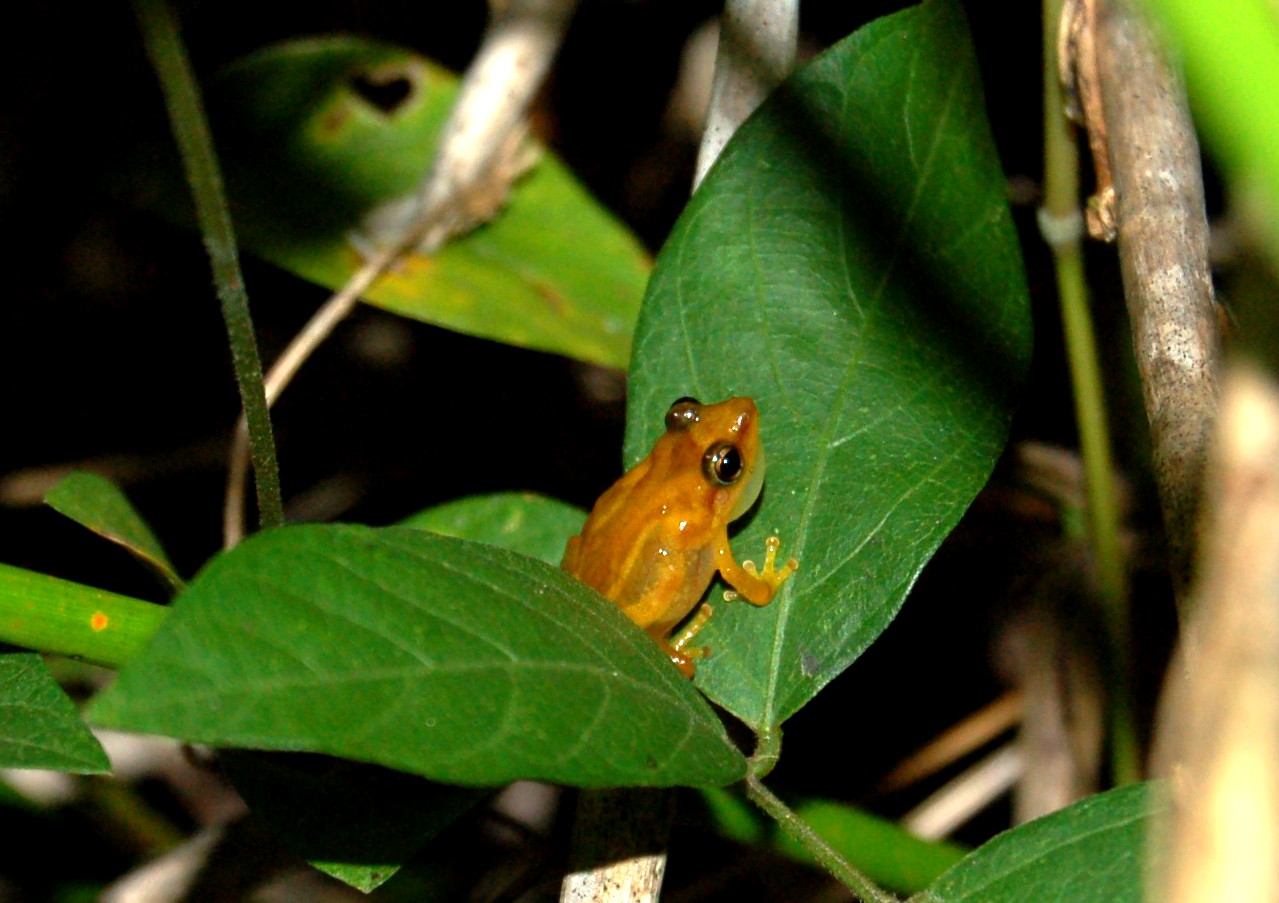
Meet the Coquí Llanero
Fact block — copy it for your StoryMap
Say hello to the coquí llanero, the smallest coquí in Puerto Rico. A coquí is a little frog famous for singing at night. This one is tiny — only about 15 millimeters long, about the width of a fingernail. Its skin is yellow to yellowish-brown, and its call is a string of short, high-pitched notes. Here is the amazing part: scientists did not discover this frog until 2005. A whole species was hiding in plain sight!
The coquí llanero (Eleutherodactylus juanariveroi), also called the Puerto Rican wetland frog, is the smallest coquí in Puerto Rico: males measure about 14.7 millimeters from snout to rump, and females about 15.8. Its skin is yellow to yellowish-brown with a light, comma-shaped mark on each side, and ridges behind its nostrils give its nose a squared-off look. Its call is a series of short, high-pitched notes. Remarkably, no one described this species until 2005, when Puerto Rican scientist Neftalí Ríos-López discovered it. He named it for Juan A. Rivero, honoring Rivero's contributions to Puerto Rican herpetology — the study of amphibians and reptiles. In a world that feels fully explored, this little frog proves new discoveries are still out there.
Where It Lives (Hint: Not El Yunque)
Fact block — copy it for your StoryMap
Surprise: this coquí does not live in El Yunque at all. It lives in just one place on Earth — a freshwater wetland in Toa Baja, on Puerto Rico's north coast. A wetland is low land that stays wet or flooded for part of the year. There, males climb onto ferns and sing to attract mates. Mothers lay their eggs — just one to five at a time — on a single kind of plant, the bulltongue arrowhead. One frog, one wetland, one special plant.
You will not find the coquí llanero in El Yunque's tabonuco or cloud forests. Its entire world is one seasonally flooded freshwater wetland at the former Sabana Seca Naval Base in Toa Baja, on Puerto Rico's northern coast. Its range may once have been larger, but most of the island's coastal wetlands were drained for farming starting in the 1500s and for urban development in the early 1900s — this wetland may have survived because the U.S. military occupied the land. Males call from perches on ferns, and females lay clutches of one to five eggs only on the bulltongue arrowhead plant (Sagittaria lancifolia), tucked where the leaves meet the stem. A thick jelly coat may protect the eggs from drying out.
Saving the Coquí Llanero
Fact block — copy it for your StoryMap
The coquí llanero is critically endangered. That means it is at very high risk of disappearing forever. Why? Because every single one lives in just one wetland. If that wetland is drained or damaged, the frogs have nowhere else to go — and people have already drained most of Puerto Rico's coastal wetlands. But there is real hope. The United States lists this frog as endangered, which means it is protected by law. Protect one wetland, and you protect a whole species.
Scientists rank the coquí llanero as Critically Endangered on the IUCN Red List — the highest threat level for a species still living in the wild. The danger comes down to geography: the entire species depends on a single wetland and the one plant where it lays its eggs. Most of Puerto Rico's coastal wetlands were drained for farms and cities long ago, so there is no backup habitat. To survive, this frog needs its wetland to stay wet and its bulltongue arrowhead plants to keep growing. People are acting: the species is listed as endangered under the U.S. Endangered Species Act, which protects the frog by law. A frog discovered in 2005 is being defended in our lifetime — and your generation gets to help finish the job.
Fast Facts
Fact block — copy it for your StoryMap
- Spanish name: Coquí llanero — in English, the Puerto Rican wetland frog
- Size: Puerto Rico's smallest coquí — males about 14.7 mm, females about 15.8 mm
- Discovered: 2005, by Puerto Rican scientist Neftalí Ríos-López
- Home: A single freshwater wetland in Toa Baja, Puerto Rico — not El Yunque
- Eggs: Clutches of 1 to 5 eggs, laid only on the bulltongue arrowhead plant
- Status: Critically Endangered (IUCN); protected under the U.S. Endangered Species Act
Where these facts come from
IUCN Red List · Wikipedia · iNaturalist — real photos & sightings