Wild Files: El Yunque · Species File No. 02 · Amphibian
Common Coquí
Eleutherodactylus coqui
Found only here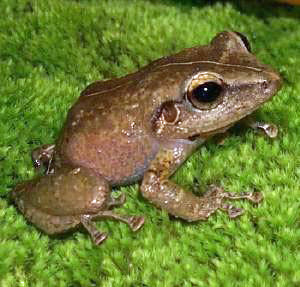
Meet the Common Coquí
Fact block — copy it for your StoryMap
Meet the coquí (say it: ko-KEE), a tiny tree frog that sings its own name. At night all over Puerto Rico, male coquís call co-quí, co-quí — and the whole island knows the sound. The coquí is a beloved symbol of Puerto Rico. It is small, about 3 to 5 centimeters long, with brown skin and sticky toe pads for climbing. Strangest of all, coquí babies skip the tadpole stage. They hatch from eggs on land as tiny froglets, ready to hop!
The common coquí (Eleutherodactylus coqui) is a small tree frog famous for the males' two-note call. Each note has a job: the co warns rival males away, and the quí invites females closer — males' and females' ears are even tuned to different notes. Males measure about 30–37 millimeters; females are bigger, about 36–52 millimeters. Coquí colors run from tan to muddy brown, sometimes dark and mottled, and their toes end in sticky pads for climbing instead of webbing for swimming. Most surprising is their life cycle, called direct development: coquís have no tadpole stage. Females lay 16–40 eggs on land, the father stands guard, and tiny fully formed froglets hatch in 17–26 days. In Puerto Rico, this little frog is an unofficial symbol of the whole island.
Where It Lives
Fact block — copy it for your StoryMap
Coquís live all over Puerto Rico — the coquí is the island's most common frog. They also live on Vieques and Culebra, two smaller islands nearby. Coquís like wet places best: damp forests, mountains, and even backyards and towns. They are nocturnal, which means they are active at night. In the daytime they hide in tree holes, under rocks, or inside bromeliads — plants whose leaves catch little pools of water. When the night air turns damp, coquís climb up into the trees to hunt and call.
The common coquí is the most abundant frog in Puerto Rico, with densities estimated at about 20,000 frogs per hectare — a hectare is roughly the size of two football fields. Its native range covers Puerto Rico and the nearby islands of Vieques and Culebra, from sea level up to about 1,200 meters in the mountains. Moisture matters most: coquís are rare in dry forests but thrive in moist broadleaf forests, mountain forests, and even towns and cities. By day they shelter in bromeliads, tree holes, and spots under trunks or rocks. When evening humidity rises, they emerge and climb toward their homes in the canopy, the leafy roof of the forest. In Puerto Rico's wet mountain forests, night belongs to the coquí chorus.
Found Nowhere Else: What Endemic Means
Fact block — copy it for your StoryMap
The coquí is endemic to Puerto Rico. Endemic means a plant or animal lives naturally in one place on Earth and nowhere else. The coquí evolved on these islands and fits into the food web like a puzzle piece: it eats insects, and birds and other hungry animals eat it. Because the coquí's only natural home is these islands, taking care of Puerto Rico means taking care of the coquí. The good news? It is still the most common frog on the island, and scientists rate it as 'Least Concern.'
An endemic species lives naturally in only one place on Earth. The common coquí is endemic to Puerto Rico, Vieques, and Culebra — it evolved there and is native nowhere else. On an island, every species is woven into the food web. Coquís are mighty insect hunters: as a population, they can eat around 114,000 invertebrates per hectare each night, and in turn they are food for birds and other predators. Endemic species need special care because their whole natural world is one small group of islands — there is no backup home. Today the coquí is listed as 'Least Concern' and remains Puerto Rico's most abundant frog. But when people accidentally carried coquís to Hawaii in potted plants, the frogs became invasive pests there — a reminder that every species belongs in its home web.
Fast Facts
Fact block — copy it for your StoryMap
- Scientific name: Eleutherodactylus coqui — the genus name means 'free toes' in Greek
- Size: males about 30–37 mm; females larger, about 36–52 mm
- Call: two notes with two jobs — the 'co' warns rival males, the 'quí' attracts females
- Life cycle: no tadpole stage — eggs hatch on land as tiny froglets while the father guards the nest
- Eggs: usually 16–40 eggs at a time, laid four to six times a year
- Status: Least Concern — Puerto Rico's most abundant frog, with about 20,000 per hectare
Where these facts come from
National Park Service · Wikipedia · iNaturalist — real photos & sightings